
URL: https://v1.desy.de/site_www-desy/content/about_desy/lead_scientists/geraldine_servant/index_eng.html
Breadcrumb Navigation
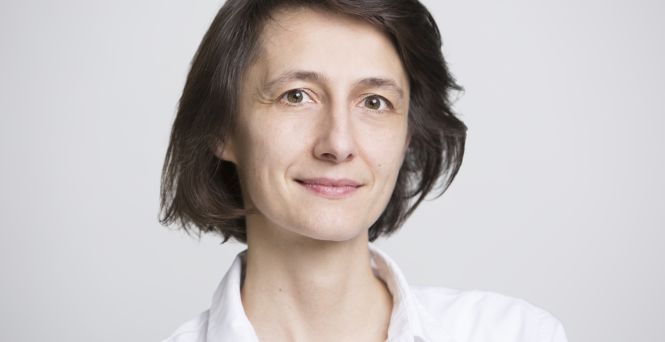
Geraldine Servant
Particle physics and cosmology
Geraldine Servant is Lead Scientist in the DESY Theory group and Professor at the University of Hamburg. Her main area of research is the interplay between particle physics and cosmology, in particular regarding dark matter and the origin of the matter–antimatter asymmetry in the universe. She has been working on models of new physics at the terascale and their phenomenology at particle colliders, with special emphasis on the cosmological consequences, such as the nature of the electroweak phase transition in the early universe and dark-matter model building.
New findings and a flood of new data are expected in this field in the near future. These data come not only from the LHC accelerator at CERN in Geneva, but also from direct searches for dark matter in underground laboratories, from indirect searches using cosmic-ray telescopes, from low-energy frontier experiments searching for axion-like particles, from cosmological surveys and simulations of large-scale structures as well as from gravitational-wave astronomy.
Academic career
| Since 2015 | DESY Lead Scientist and Professor at the University of Hamburg |
| 2013-2015 | ICREA Research Professor, Institut de Fisica d'Altes Energies, Universitat Autonoma de Barcelona, Spain |
| 2008-2013 | Junior Staff Scientist, CERN Theory Division under ERC Starting Grant |
| 2006-2008 | Fellow, CERN Theory Division |
| 2003-2013 | Research Scientist, Institut de Physique Théorique (IPhT), CEA Saclay, France (on leave after 2008) |
| 2001-2004 | Joint Research Fellow, University of Chicago (Enrico Fermi Institute) and Argonne National Laboratory, USA |
| 1998-2001 | PhD, Université Paris XI and CEA Saclay, France |
| 1994-1998 | Studies of Physics, École Normale Supérieure de Lyon, France |
Memberships
|
Since 2018
|
High Energy Particle Physics Board, European Physical Society (EPS)
|
|
Since 2018
|
Advisory Board, Mainz Institute for Theoretical Physics (MITP)
|
|
Since 2012
|
Program Advisory Committee, Munich Institute for Astro- and Particle Physics (MIAPP)
|
|
2009-2017
|
Scientific Committee, Institut d’Etudes Scientifiques de Cargèse (IESC), France
|
